

Or Cost You If You’re Not Ready
Tax laws changed, again. This time, some of the tax changes are good news for everyday taxpayers. Because of the One Big Beautiful Bill Act (OBBBA), there are new opportunities to save money, plus a few things that have gone away that you’ll want to know about.
We’ve broken it down here.
Good News for Charitable Givers — Even If You Don’t Itemize
This is big. If you take the standard deduction, you’ve always had to choose between your standard deduction or your charitable gifts, not both. Starting in 2026, that changes.
You can now deduct up to $1,000 in cash donations (or $2,000 if you’re married filing jointly) to qualifying charities in addition to your standard deduction.
A few things to keep in mind:
- For any cash gift, save your bank statement or a written receipt from the charity.
- For any single gift of $250 or more, you’ll need a written acknowledgment from the charity, no exceptions.
If you itemize, there’s a new rule. Your charitable deductions only count to the extent they’re above 0.5% of your adjusted gross income (AGI). For someone with a $200,000 income, that means only gifts above $1,000 would be deductible. It’s a small floor, but worth knowing.
If you’re in the top 37% tax bracket (over $768,700 for joint filers; over $640,600 for single filers), the benefit of itemized deductions, including charitable gifts, is capped at 35%. Still valuable, just slightly reduced.
2026 Standard Deduction Amounts
Here’s a quick look at what you can deduct this year just for filing. If you’re 65 or older, 2026 is a very good year for you. The additional deductions are substantial.

The senior addition is subject to income phaseouts. Ask us if this applies to you.
2026 Mileage Rates
If you drive for business or charitable purposes, here’s what you can deduct per mile:
- Business driving: 72.5 cents per mile.
- Charitable driving: 14 cents per mile.
Keep a mileage log with the date, destination, and purpose for every trip you want to deduct. The IRS requires documentation, and a simple app or spreadsheet works great.
“Trump Accounts” — A New Way to Save for Your Kids
Under a new section of the tax code (Section 530A), the government has introduced a new tax-advantaged savings account for children, sometimes called a “Trump account.” Think of it like an IRA for kids.
Here’s what you need to know:
- Who qualifies: Children under 18 with a Social Security number.
- Free government money: Children born between January 1, 2025, and December 31, 2028, may receive a one-time $1,000 government contribution (for eligible U.S. citizens).
- How much you can contribute: Up to $5,000 per year from family or others; employer contributions (up to $2,500) count toward that cap.
- Where the money is invested: Low-cost index funds and ETFs tracking U.S. stock markets — no picking individual stocks.
- When your child can access it: Generally, not until they turn 18.
- When it launches: Contributions are expected to begin after July 4, 2026.
These accounts could be a great addition to or an alternative to a 529 college savings plan, depending on your goals.
Electric Vehicles and Home Energy Credits — Gone (For Now)
If you’ve been thinking about buying an electric vehicle or making energy-efficient upgrades to your home, here’s an important update. If you were counting on these credits to offset the cost of a solar panel installation or an EV purchase, now is the time to revisit your plans.
Several major tax credits have expired.
- The up-to-$7,500 EV tax credit ended after September 30, 2025
- The residential clean energy credit and the energy-efficient home improvement credit both expired at the end of 2025
Estate and Gift Tax Updates
If you’re thinking about leaving money or assets to your family, 2026 is a great year to talk to us. If you have an estate plan, consider this:
- Annual gift exclusion: You can give up to $19,000 per person in 2026 (the same as in 2025) without it counting toward your lifetime exemption. That’s $38,000 for married couples giving to the same person.
- Estate tax exemption: The OBBBA made the higher exemption permanent and raised it to $15 million per person, effective in 2026, with inflation adjustments going forward. This is a major win for families doing estate planning.
Important: Watch Out for IRS Scams
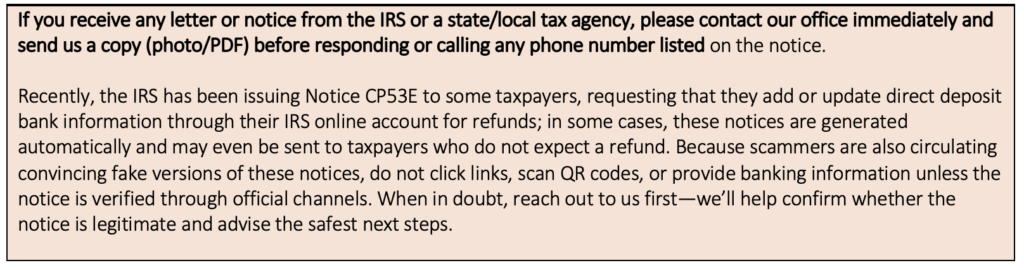
The IRS has recently been sending out a notice called CP53E, which asks taxpayers to update their direct deposit information for refunds. Here’s the problem. Scammers are sending out convincing fake versions of this same notice.
Do NOT:
- Click any links in a notice you’re unsure about.
- Scan QR codes from tax notices.
- Call the phone numbers listed on the notice without verifying them first.
- Enter banking information unless the notice has been verified.
DO:
- Forward any IRS or state tax notice to our office before responding.
- Send us a photo or PDF of the notice.
- Let us verify whether it’s legitimate.
You can also check your official IRS Online Account directly to see if any action is needed. When in doubt, reach out to us.
Ready to Make These Changes Work for You?
There’s a lot happening with tax law in 2026, and some of these changes could make a real difference for you and your family.
Don’t wait until tax season to start planning. The best time to prepare is now.
Call us at 484-428-3160 or reach out online.